Breathwork for Anxiety: 6 Techniques that Work and the Science Behind them
Table of Contents
Toggle- Breathwork for Anxiety: 6 Techniques that Work and the Science Behind them
- Why Does Anxiety Affect your Breathing?
- The Anxiety-Breathing Feedback Loop
- How Slow Breathing Calms your Nervous System
- Breathwork and Anxiety: The Research
- 6 Breathwork Exercises for Anxiety
- Guided Breathwork for Anxiety
- How to Build a Daily Breathwork Routine for Anxiety
- Three Additional Habits to Help Ease Anxiety
- 1. Change your Posture: The Posture-Breath-Emotion Connection
- 2. Breath through your Nose
- 3. Breathe Low, Slow, and All the Way Out
- Breathwork and Anxiety: The FAQs
- How long does breathwork take to reduce anxiety?
- What's the best breathing technique for a panic attack?
- Is breathwork the same as meditation when it comes to anxiety?
- When to Seek Professional Support
- Australian Support Resources:
Anxiety has a way of hijacking the body before the mind can even register what’s happening. Your shoulders creep toward your ears, your chest tightens, and suddenly you’re taking short, shallow breaths that make everything worse. It’s a cycle most people have experienced – and one that breathwork is uniquely positioned to interrupt.
Anxiety disorders are the most common mental health condition in Australia, affecting more than 3.4 million people, which is roughly one in six Australians, in any given year. Globally, the prevalence of anxiety and depression rose by 25% in the first year of the COVID-19 pandemic alone.
Fewer than 20% of people who seek help for anxiety receive appropriate treatment; and while breathwork won’t replace professional care altogether, it’s free, evidence-backed, and available to anyone.
This article explains why and how breathwork for anxiety works, walks through six techniques, and gives you a practical framework for building a daily practice.
Why Does Anxiety Affect your Breathing?
To understand why breathwork helps, it helps to understand what anxiety does to the body, and the link between breathing and anxiety.
When your brain perceives a threat – whether it’s a genuine emergency or a difficult email from your boss – it activates the sympathetic nervous system, better known as the fight-or-flight response. Breathing becomes faster and shallower, moving from the diaphragm up into the chest. This accelerated breathing pattern rapidly changes the balance of oxygen and carbon dioxide in your blood – CO2 drops, blood vessels constrict ((vasoconstriction), and you may begin to feel dizzy, tingly, or even more panicked. The shallow breathing that was supposed to help you respond to danger, has now amplified your anxiety.
The Anxiety-Breathing Feedback Loop
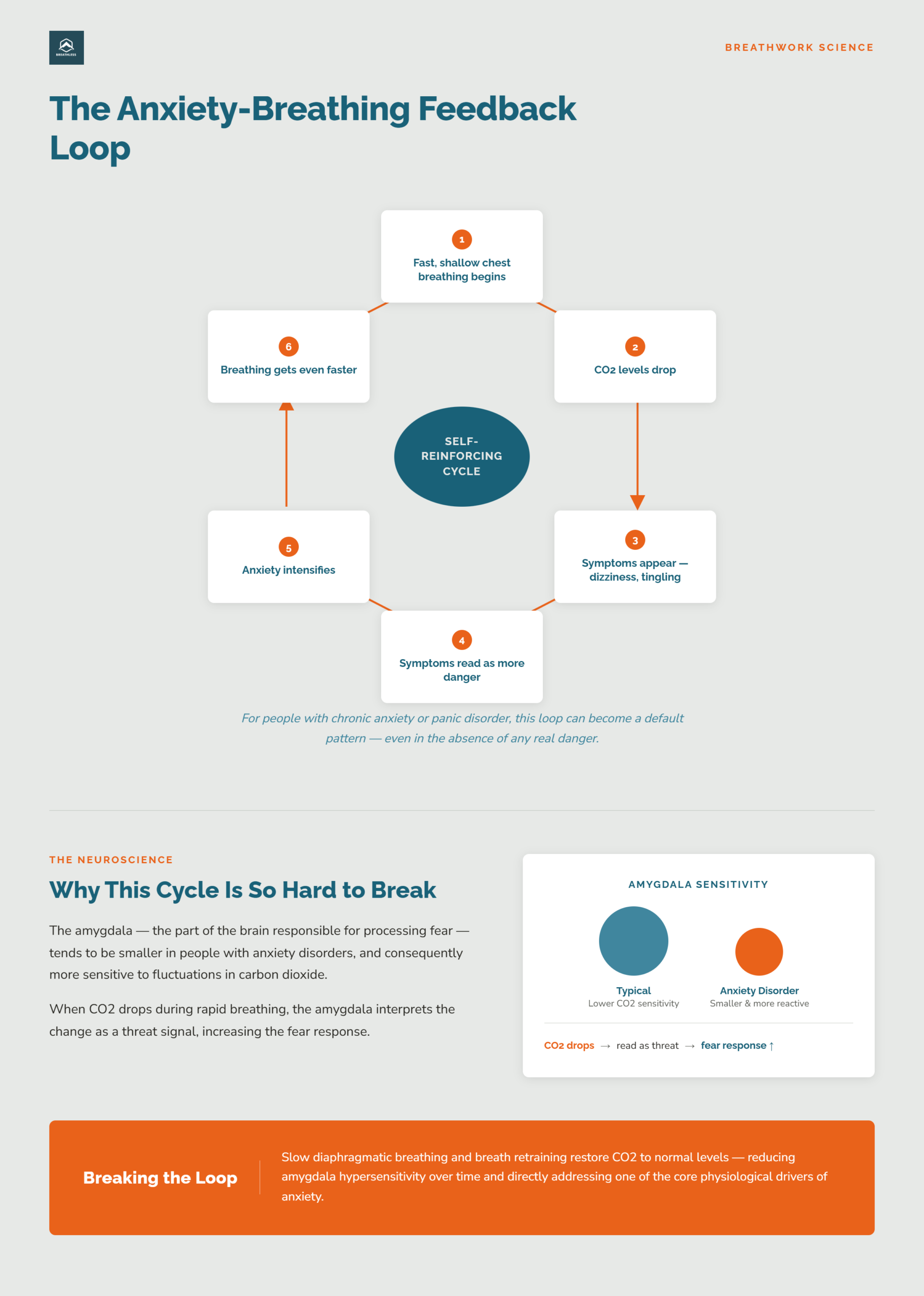
This shallow breathing creates a self-reinforcing cycle. Anxiety triggers fast chest breathing → CO2 drops → physical symptoms like dizziness and tingling appear → the symptoms are interpreted as more danger → anxiety intensifies → breathing gets faster. For people with chronic anxiety or panic disorder, this loop can become a default pattern even in the absence of any real danger.
And there’s a neurological reason this cycle can be so hard to break. The amygdala – the part of the brain responsible for processing fear – tends to be smaller in people with anxiety disorders, and consequently more sensitive to fluctuations in carbon dioxide. When CO2 drops during rapid breathing, the amygdala interprets the change as a threat signal, increasing the fear response. Breathwork techniques that restore carbon dioxide to normal levels – particularly slow diaphragmatic breathing and breath retraining approaches – have been shown to reduce this hypersensitivity over time, directly addressing one of the core physiological drivers of anxiety.
How Slow Breathing Calms your Nervous System
The good news is that this loop runs both ways. The vagus nerve – the longest cranial nerve in the body, running from the brainstem to the abdomen – is the main conduit of the parasympathetic nervous system, the “rest and digest” counterpart to fight-or-flight. Slow, deep diaphragmatic breathing has been shown to stimulate vagal tone, activating the parasympathetic system, reducing heart rate, lowering blood pressure, and producing measurable improvements in heart rate variability (HRV) – a key physiological marker of stress resilience.
In practical terms: when you slow your breathing down and extend your exhale, you are sending a direct, bottom-up signal to your nervous system that the threat has passed. Your physiology shifts first and your emotional state follows.
Breathwork and Anxiety: The Research
A meta-analysis of 12 randomised controlled trials involving 785 adults found that breathwork was associated with significantly lower levels of stress, anxiety, and depressive symptoms compared to control conditions, with effect sizes ranging from small to medium. A separate study on breathwork and anxiety, found significant improvement across every anxiety measure tested, including heart rate variability, panic symptoms, severity, and related cognitions – with these results still there at the six-month follow up.
"There is a strong bi-directional relationship between anxiety disorders and the way we breathe.” "Breathwork has been clinically proven to be a safe, effective and accessible therapy - it could be a fundamental part of the solution to the explosion in anxiety that we are seeing worldwide."
Johannes Egberts
Check out this article to read more about the research behind breathwork and anxiety.
6 Breathwork Exercises for Anxiety
Below are six of the most well-evidenced techniques top help alleviate anxiety.
1. Diaphragmatic (Belly) Breathing
Most people default to shallow chest breathing without realising it. Diaphragmatic breathing corrects that by using the large muscle below the lungs to drive deeper, more efficient breaths and forming the foundation of many other breathwork techniques.
Diaphragmatic breathing reduces respiratory rate by 32–50% and increases oxygen saturation, both of which directly stimulate parasympathetic activation.
How to do it:
- Lie on your back or sit upright in a chair.
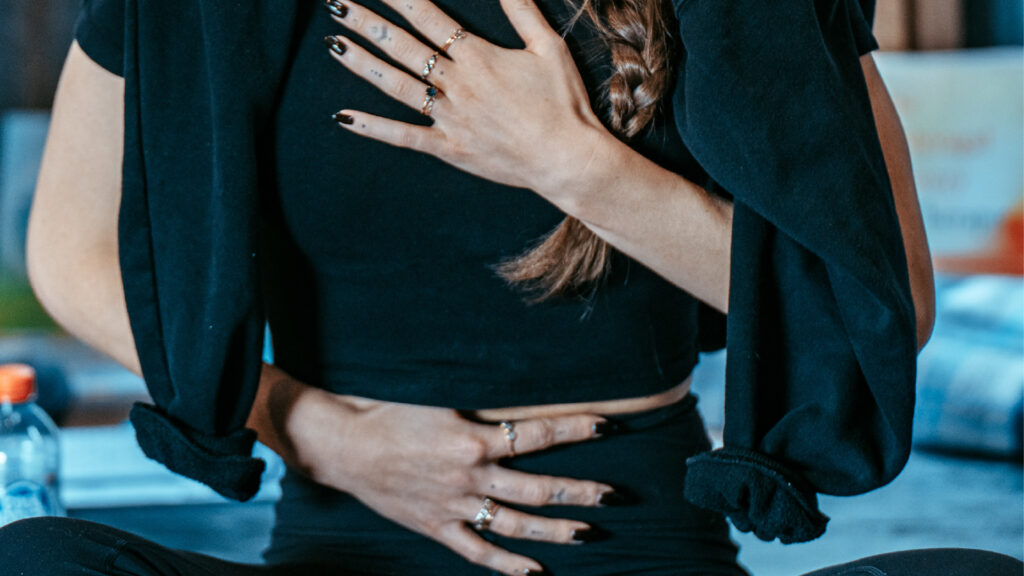
- Place one hand on your chest, the other on your stomach, just below the ribcage.
- Inhale slowly through your nose for a count of 4, feeling your abdomen rise against your hand. Your chest should stay relatively still.
- Exhale slowly through pursed lips for a count of 6-8, feeling the abdomen deflate.
- Repeat for 5-10 minutes.
The hand placement is the key to proper technique; if your chest is rising more than your belly, you’re still chest breathing.
2. Box Breathing
Box breathing (also called square breathing) uses four equal phases: inhale, hold, exhale, hold – each for four counts. The technique has been used by US Navy SEALs and first responders for decades to manage acute stress and maintain cognitive performance under pressure, and the underlying physiology explains why: the equal-ratio pattern produces approximately five to six breath cycles per minute, which is associated with increased parasympathetic tone and improved HRV.
A 2023 Stanford study confirmed that box breathing reduced both anxiety and respiratory rate.
How to do it:
- Sit upright, feet flat on the floor.
- Exhale fully to empty your lungs.
- Inhale through your nose for 4 counts.
- Hold your breath for 4 counts.
- Exhale slowly for 4 counts.
- Hold for 4 counts before the next inhale.
- Repeat for 4-5 cycles (approximately 1-2 minutes) or longer as needed
A useful visual to help with this technique is to imagine tracing the four sides of a square, one side per count.
3. 4-7-8 Breathing
Developed by integrative medicine physician Dr. Andrew Weil, the 4-7-8 technique extends the exhale significantly beyond the inhale – a technique that is particularly effective for activating the parasympathetic nervous system. The extended exhale is believed to stimulate the vagus nerve more intensively than equal-ratio breathing, making it especially well-suited for moments when anxiety has already spiked or when you’re trying to sleep.
How to do it:
- Place the tip of your tongue against the ridge of tissue behind your upper front teeth and keep it there throughout.
- Exhale completely.
- Inhale quietly through your nose for a count of 4.
- Hold your breath for a count of 7.
- Exhale completely for a count of 8.
- This is one breath. Repeat for four full cycles.
4. Resonant (Coherent) Breathing
Resonant breathing – or what we like to call Heart Coherence breathing – is a calming breathing practice that places the heart, lungs, and circulation into a state of coherence. This technique is the most-studied, balanced breathing technique in the world and involves breathing at a rate of approximately five full breath cycles per minute.
This can be achieved by inhaling for five counts and exhaling for five counts. At this rate, breathing synchronises with the body’s natural cardiovascular rhythms, maximising HRV and producing what researchers describe as psychophysiological coherence.
This technique is less useful in acute moments of panic — the pace can feel too slow when anxiety is high. Its power lies in regular daily practice, which gradually raises the baseline threshold at which your nervous system enters a stress response.
How to do it:
- Sit up straight, or lie in a comfortable position, relaxing your shoulders and abdomen.
- Inhale slowly through your nose for a count of 5 seconds.
- Without pausing, exhale slowly through your nose for a count of 5.
- Maintain this pattern for at least 5 minutes, working up to 10-20 minutes over time.
Notes: Each breath should feel like a circle. If 5 seconds feels too long, or too short, adjust according to what your body is telling you – remember the goal is approximately 5-6 full breaths per minute.
5. Physiological Sigh (Cyclic Sighing)
The physiological sigh is the most recent addition to the evidence base. In a 2023 randomised controlled trial published in Cell Reports Medicine, Stanford University researchers compared cyclic sighing, box breathing, cyclic hyperventilation, and mindfulness meditation across 111 participants over four weeks. Cyclic sighing produced the greatest daily increases in positive affect and was the most effective technique at reducing physiological arousal and respiratory rate.
This is how it works: the double inhale reinflates the small air sacs in the lungs that collapse under stress, restoring efficient gas exchange. The extended exhale then clears excess CO2 and activates the vagus nerve; and within one or two breaths, your physiology shifts.
How to do it:
- Inhale through your nose until your lungs feel about two-thirds full.
- Take a second, short “top-up” inhale through your nose to fully expand the lungs.
- Exhale slowly and completely through your mouth – long, gentle, and relaxed.
- Repeat 1-3 sighs for an immediate reset, or continue for 5 minutes for sustained benefit.
This technique is ideal during a moment of acute anxiety such as in a meeting, before a presentation, or when you feel panic beginning to build.
6. Humming Breathwork (Bhramari)
Known as Bhramari in yogic breathwork, this technique involves humming through the exhale, which extends exhalation and encourages diaphragmatic breathing. Research shows the vibration increases vagal nerve activity, activating the parasympathetic nervous system, raising heart rate variability, and lowering stress.
This is how it works: the vibration from humming stimulates the vagus nerve through the throat and sinuses, while the long exhale keeps you in a parasympathetic state. Humming also boosts nitric oxide production in the sinuses, which helps regulate blood vessel dilation and supports healthy blood pressure.
How to do it:
- Sit comfortably, close your eyes, and relax your face.
- Place your index fingers on the small flap of cartilage at each ear canal and press gently to block outside sound.
- Inhale deeply and gently through your nose.
- With your mouth lightly closed and teeth slightly apart, hum loudly all the way to the end of your exhale.
- Focus on the sound and the sensation of the vibration.
- Repeat for 5 rounds, building up over time.
This technique is ideal when you need to settle a racing mind – before bed, after a stressful day, or any time you have privacy to make sound.
Guided Breathwork for Anxiety
If you’d rather be guided through a breathwork, the videos below will walk you through a few different breathwork flows which may help alleviate anxiety.
How to Build a Daily Breathwork Routine for Anxiety
Weeks 1-2: One Technique, One Time Slot, Just Five Minutes a Day
Choose one technique and pair it with an existing habit, like your morning routine, the commute to work, or the five minutes before bed. Consistency matters more than duration at this stage. Diaphragmatic breathing or resonant breathing are the most accessible starting points for beginners.
The 2023 Stanford study showed meaningful improvements in mood and anxiety from just five minutes of daily practice over four weeks, and five minutes is achievable for almost everyone!
Weeks 3 and Beyond: Expanding your Practice
Once one technique is habitual, you can add a second technique for acute moments of stress. Box breathing or the physiological sigh are great to use during situations that can cause anxiety. Track how you feel over time – meaning not just in the moment, but your baseline mood and anxiety levels across the week.
Apps that can support your practice include Smiling Mind, Insight Timer and the Breathless Training app.
Three Additional Habits to Help Ease Anxiety
1. Change your Posture: The Posture-Breath-Emotion Connection
The way you hold your body shapes the way you breathe, and the way you breathe shapes the way you feel. Research into breathing patterns and emotions shows that adopting a slumped posture doesn’t just restrict your breath; it actively generates negative emotional states, including sadness, stress, and anxiety. The reverse is equally true: change your posture, and you change what’s physiologically possible.
Good posture e.g. sitting or standing tall, spine long, chest open, shoulders relaxed and away from your ears, creates the space your body needs to breathe well. It allows full access to the diaphragm, the primary breathing muscle, which draws air into the lower third of the lungs where oxygen exchange is most efficient. Chest breathing, by contrast, delivers significantly less oxygen, meaning your brain compensates by breathing faster and more shallowly, feeding directly into the stress-anxiety loop.
When you’re slumped, your diaphragm is compressed and can’t fully engage. Your body still needs oxygen, so it recruits the smaller muscles around your neck and chest as a backup. These muscles aren’t designed for the thousands of breaths you take each day – they fatigue quickly, generating tension, trigger points, headaches, and jaw and neck pain. Over time, this pattern becomes a habit of shallow, rapid, effortful breathing that keeps your nervous system primed for threat.
Improving your posture allows you to help break that cycle.
Try this now
Without changing anything, notice how you’re sitting or standing. Are you slumped forward, shoulders rounded, chest closed? Or is your body upright and open? Notice the quality of your breath, and any emotions that accompany it. Awareness is the first step, because you can’t change a habit you haven’t noticed.
2. Breath through your Nose
Of all the breathing habits you can build, this one may have the biggest impact. Switching from mouth to nose breathing is a simple change that affects almost every aspect of how your body manages stress, oxygen, and nervous system tone.
Mouth breathing tends to be faster and shallower and keeps the stress response active. It also disrupts the balance of oxygen and carbon dioxide the body needs to feel calm, meaning it can perpetuate anxiety symptoms even when nothing externally stressful is happening.
Nose breathing slows everything down. It draws air more naturally to the diaphragm, which, as we’ve seen, is not just a breathing muscle but one directly linked to emotional regulation. Breathing low and slow through the nose activates the parasympathetic nervous system, stimulates the vagus nerve, and over time, increases your resilience to stress. Like any muscle, the more you use the diaphragm, the stronger it becomes, and the higher the threshold at which your nervous system tips into a stress response.
If nose breathing feels difficult or unfamiliar, start small. Aim to increase the time you spend consciously breathing through your nose each day, building gradually. If you’re finding it hard to do alone, working with a breathwork instructor or joining a structured breathwork class can help you retrain the pattern properly.
Try this now
Without changing anything, notice how you’re breathing. Nose or mouth? Check in again later by setting a timer at intervals throughout the day. Like posture, mouth breathing often happens without most people realising it.
3. Breathe Low, Slow, and All the Way Out
As we’ve mentioned – chest breathing is the default for many people. Diaphragmatic breathing is calmer, more efficient, and you’ll feel the difference within a few breaths.
To find it, place your hands over your lower ribs – fingers at the front, palms spanning the sides, thumbs reaching around the back. As you inhale, breathe into your hands. Let the belly, ribs, and side body expand outward in all directions. If only your chest rises, you’re still chest breathing.
The exhale matters just as much. When you inhale, your sympathetic nervous system activates and your heart rate rises slightly. When you exhale, your parasympathetic nervous system takes over and brings it back down. The longer the exhale, the more time you spend in that calmer state.
Try this now
Without changing anything, notice whether you’re chest breathing or belly breathing. Count your inhale – the ideal at rest is around 5 seconds. Then count your exhale – aim for longer than your inhale, ideally 6 seconds or more. Take five breaths focusing only on the exhale. Let the belly soften for each inhale. Notice how you feel at the end – do you feel any calmer?
Breathwork and Anxiety: The FAQs
How long does breathwork take to reduce anxiety?
For acute relief like reducing the physical symptoms of anxiety in the moment, techniques like the physiological sigh and box breathing, can have an effect within minutes. For longer-term reductions in anxiety, research points to four weeks of daily practice before lasting change in baseline anxiety becomes noticeable.
What's the best breathing technique for a panic attack?
The physiological sigh is probably the fastest-acting option for a panic attack in progress: one to three sighs can interrupt the hyperventilation cycle within seconds. When the intensity eases, switching to box breathing can help you remain calm.
Is breathwork the same as meditation when it comes to anxiety?
Not quite. Meditation typically involves non-directive attention practices like observing thoughts without reacting to them.
Breathwork is more active (that’s why it’s called breath ‘work’). You’re deliberately manipulating your breathing through different techniques.
A 2023 study found that five minutes of breathwork outperformed five minutes of mindfulness meditation for reducing physiological arousal, suggesting the two work through different mechanisms and may complement each other.

When to Seek Professional Support
Breathwork can help you manage anxiety symptoms in the moment and build resilience over time. But if your anxiety is persistent, severe, or interfering with your work, relationships, or daily life, it’s important to speak with a healthcare professional.
Australian Support Resources:
- Beyond Blue – 1300 22 4636 or beyondblue.org.au – information, support, and referrals for anxiety and depression.
- Lifeline – 13 11 14 – 24/7 crisis support.
- Headspace – headspace.org.au – mental health support for young people aged 12–25.
- Healthdirect – 1800 022 222 – free health advice from registered nurses, 24/7.
Medical Disclaimer
The information in this article is intended for educational purposes only and does not constitute medical advice. Breathing exercises are generally safe for healthy adults, but individual responses can vary. If you have a pre-existing medical condition, including cardiovascular disease, epilepsy, respiratory conditions, severe anxiety or panic disorder, please consult a qualified healthcare professional before beginning any new breathing practice. If you experience dizziness, chest pain, or feel unwell during any breathing exercise, stop immediately and seek medical advice. Breathless does not diagnose, treat, or cure any medical condition.